



RAPTOR Primary Injection Test System: Frequently Asked Questions About High-Current Testing
Primary injection testing verifies more than an individual relay or device. By injecting current from the primary side, engineers can test a much larger part of the protection chain under conditions that more closely represent the real installation.
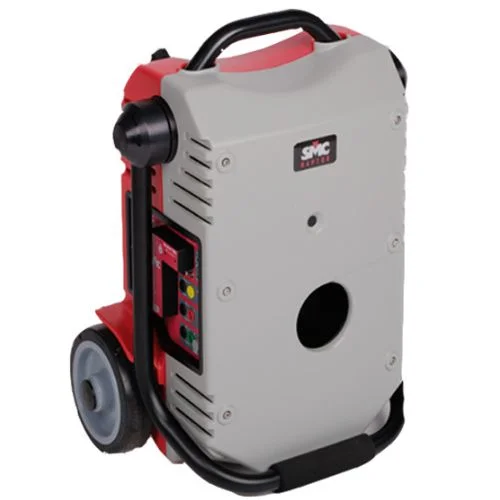
RAPTOR is EuroSMC’s multifunctional primary injection test system, designed for portable, regulated and scalable high-current testing. It can be used for current transformer testing, protection relay testing, circuit breaker and switchgear testing, contact resistance measurements and other substation commissioning and maintenance applications.
Below we answer some of the most common questions about primary injection testing and the RAPTOR system.
What is primary injection testing?
Primary injection testing applies current — and, for certain tests, voltage — directly to the primary circuit of the equipment being tested.
This is different from secondary injection testing, where electrical signals are applied directly to the inputs of a protection relay.
Because current is injected from the primary side, a primary injection test can verify a larger part of the protection system, potentially including the current transformer, secondary wiring, connections, protection relay and tripping chain.
It is therefore particularly valuable during substation commissioning and complete protection-system verification.
What is the RAPTOR system?
RAPTOR is a portable and modular primary injection test system for medium- and high-voltage electrical installations.
The main unit integrates high-current generation, measurements, digital control and test functions. Additional units and accessories can be added when an application requires more power, high-voltage injection or three-phase primary injection.
This allows one test platform to address many different commissioning and maintenance tasks.
How much current can RAPTOR inject?
The RAPTOR main unit can provide up to 9,500 A, depending on the test-loop impedance, cable arrangement and test configuration.
For applications requiring more power, RAPTOR-SL units can be added, allowing configurations of up to 15,000 A.
The maximum current available in a real test is therefore not determined by the headline current rating alone. Loop impedance, test-lead length and cross-section, connection quality and test configuration all influence the current that can be delivered to the load.
Is RAPTOR a portable high-current injection test set?
Yes. The RAPTOR main unit weighs approximately 35 kg / 77 lb.
Portability is particularly important in substations because it allows the primary injection equipment to be positioned closer to the asset being tested. Shorter high-current connections can reduce losses and simplify the test setup.
This represents a significant change from traditional large, heavy variac-based high-current test systems.
What electrical equipment can be tested with RAPTOR?
Depending on the system configuration, RAPTOR can support applications involving:
- current transformers;
- voltage and power transformers;
- protection relays through primary injection;
- circuit breakers and switchgear;
- reclosers and sectionalizers;
- contact and connection resistance;
- busbars;
- ground grids;
- step-and-touch voltage testing;
- polarity checks.
The correct system configuration depends on the particular test requirement.
Where is RAPTOR particularly useful?
RAPTOR is particularly useful in applications where high-current primary injection must be combined with portability, flexible test configurations and limited access to the equipment under test.
Its compact and modular design makes it suitable not only for conventional substations and power plants, but also for modern critical infrastructure and installations where transporting and positioning traditional high-current test equipment can be difficult.
Primary injection testing in data centers and AI infrastructure
The rapid expansion of artificial intelligence is driving the construction of increasingly power-intensive data centers. As these facilities grow in electrical capacity, reliable power distribution and protection become critical to maintaining availability and preventing electrical faults from affecting essential computing infrastructure.
RAPTOR does not test servers, GPUs or AI systems themselves. Instead, it can be used to test elements of the electrical infrastructure that supplies and protects data centers, wherever primary injection testing is required.
Typical applications may include:
- primary injection testing and circuit breaker testing of low-voltage and medium-voltage circuit breakers;
- trip-time testing of air circuit breakers (ACBs) and moulded-case circuit breakers (MCCBs);
- verification of current transformers and their polarity, ratio and associated protection circuits;
- testing protection relays as part of the complete primary protection chain;
- testing switchgear and busbar sections;
- low-resistance measurements on electrical connections and contacts;
- verification of protection schemes during commissioning, maintenance or major electrical modifications.
For data centers, where continuity of service and electrical reliability are particularly important, primary injection testing can help verify that the complete protection chain operates as expected rather than testing individual protection devices in isolation.
Why is RAPTOR useful in confined or difficult-to-access spaces?
Traditional high-current primary injection equipment can be large and heavy. The RAPTOR main unit weighs approximately 35 kg / 77 lb and is designed to be transported and positioned close to the equipment being tested.
This can be particularly advantageous in installations where access, available space or cable routing is restricted. Bringing the high-current source closer to the test object can also reduce the length of high-current test cables and the associated power losses.
Primary injection testing on ships and marine installations
Ships and other marine installations contain electrical distribution and protection equipment in machinery rooms, switchboard areas and other locations where available working space can be limited.
A compact primary injection system can therefore simplify the testing of suitable electrical assets such as circuit breakers, current transformers, protection circuits, switchgear and low-resistance connections, while reducing the need to move large conventional high-current test equipment through restricted areas.
RAPTOR’s portability and modular configuration are particularly useful when the test equipment needs to be moved between different electrical rooms or decks during commissioning and maintenance activities.
Primary injection testing in wind turbines and wind farms
Wind turbines also present specific access and logistics challenges. Electrical equipment may be distributed between the turbine, tower, transformer and associated switchgear, while available working space inside some areas of the installation can be restricted.
For applicable primary electrical tests, RAPTOR’s compact design makes it easier to transport the test system to the equipment rather than relying on large conventional high-current sources.
Depending on the electrical architecture of the installation, relevant applications can include testing current transformers, circuit breakers, protection circuits, switchgear and electrical connections during commissioning, preventive maintenance or troubleshooting.
Other applications where portability matters
The same advantages can be relevant in industrial plants, renewable-energy installations, underground facilities and other sites where high-current testing must be performed close to the electrical equipment.
In these environments, the combination of high-current capability, automatic regulation, modularity and portability can make primary injection testing easier to perform where access would otherwise be a limiting factor.
Can RAPTOR test current transformers?
Yes. Current transformer testing is one of RAPTOR’s main applications.
Depending on the test method and system configuration, RAPTOR can be used to evaluate parameters including:
- CT ratio;
- polarity;
- burden;
- phase-angle error;
- magnetization curve;
- knee point;
- operation of the CT as part of the complete protection circuit.
Where practical, testing with primary current provides a particularly representative verification of how a current transformer will operate within the actual protection system.
Can RAPTOR test protection relays?
Yes, but it is important to distinguish between primary and secondary relay testing.
With RAPTOR, current is injected from the primary side. This means the test can include the CT, secondary wiring and relay response as part of the same verification.
If the objective is to test the protection relay itself by applying precise current and voltage signals directly to its inputs, a secondary injection relay test set, such as the Quasar Smart Relay Tester or MENTOR 12, will normally be more appropriate.
The two test methods are complementary.
Can RAPTOR be used for circuit breaker testing?
Yes. RAPTOR can be used in several circuit breaker and switchgear applications, particularly where high-current injection or complete protection-chain verification is required.
It can also support resistance-related testing and primary trip verification.
For detailed mechanical and timing analysis — including opening and closing times, pole synchronization, coil current, travel and speed — EuroSMC offers dedicated circuit breaker analyzers such as the PME 700 TR and PME 500 TR.
What is the difference between RAPTOR, RAPTOR-SL, RAPTOR HV and TriRaptor?
They are part of the same platform but address different test requirements.
RAPTOR is the main unit and the core of the system.
RAPTOR-SL adds output power for applications requiring higher injection current.
RAPTOR HV extends the system to applications requiring high AC voltage, up to 2,000 V.
TriRaptor uses RAPTOR technology to provide stabilized three-phase high-current primary injection for applications requiring a three-phase source.
This modular architecture allows the system to be configured around the actual test application.
Does RAPTOR automatically regulate the test current?
Yes.
One of RAPTOR’s key design objectives is to eliminate the slow manual adjustment traditionally associated with variac-based primary injection systems.
Electronic regulation and digital control allow the system to maintain the selected test magnitude as the load changes.
This is particularly useful when a test requires a specific current to be reached and maintained consistently.
Can RAPTOR operate at variable frequency?
Yes. The digital amplifier in the main unit supports variable-frequency operation.
This increases the range of applications available compared with a high-current source limited to a single fixed frequency.
Does RAPTOR always replace a traditional primary injection test set?
Not necessarily.
RAPTOR is designed as a modern and flexible platform covering a wide range of primary injection applications, but test equipment should always be selected according to the required current, voltage, output power, duty cycle, load and test procedure.
EuroSMC also offers the traditional LET primary injection range for applications where that architecture is appropriate.
The most useful question is therefore not simply “How many amps do I need?” but how much current must be delivered into the real load, and for how long?
How do I choose the right RAPTOR configuration?
Before selecting a configuration, define:
- the asset to be tested;
- the required test current or voltage;
- the expected test-loop impedance;
- the required test duration;
- whether the test is single-phase or three-phase;
- whether high-voltage injection is required;
- which measurements must be recorded;
- the portability requirements of the test team.
This information determines whether the main RAPTOR unit is sufficient or whether RAPTOR-SL, RAPTOR HV, TriRaptor or other accessories are required.
Primary and secondary injection testing: complementary methods
Secondary injection is particularly effective for accurately testing relay functions, settings, characteristics and protection logic.
Primary injection goes further by verifying system behaviour from the primary circuit.
For a complete protection commissioning and maintenance strategy, the two approaches do not compete: they complement each other.
Secondary injection helps demonstrate that the relay performs correctly. Primary injection helps demonstrate that the complete protection system responds as expected.
Need help selecting a RAPTOR configuration?
The right configuration depends on the application, required current and characteristics of the installation.
Explore the RAPTOR Primary Test System and EuroSMC’s primary injection testing solutions, or contact EuroSMC to define the appropriate configuration for your application.

