



AI Data Center Electrical Reliability: Why Primary Injection, Secondary Injection and Circuit Breaker Testing Matter
Artificial intelligence is changing what a modern data center requires from its electrical infrastructure. As AI clusters push more power into every hall, the tolerance for hidden protection defects becomes much smaller. The International Energy Agency says data centers used around 415 TWh of electricity in 2024 and could reach about 945 TWh by 2030, with AI as the main growth driver. Uptime Institute also reports that power issues remain the most common cause of serious and severe data center outages, while Schneider Electric notes that AI-ready facilities are already seeing rack densities above 100 kW in some deployments.
In that environment, electrical testing cannot be treated as a box-ticking exercise. A data center needs verified breaker performance, reliable relay logic, and traceable commissioning data before energization and throughout the asset life cycle. That is why a serious testing program for an AI data center should combine primary injection, secondary injection and dedicated circuit breaker testing rather than relying on only one method.
Why primary injection matters in an AI data center
Primary injection testing matters because it validates the whole protection path under real current. It checks the current transformers, wiring, relay inputs, trip logic and breaker operation as one system, which is exactly what a commissioning team needs when energizing new switchgear, verifying bus ties, testing low-voltage breakers or proving feeder selectivity.
In practice, primary injection helps reveal the kind of issues that secondary-only checks can miss: incorrect CT ratios, wrong polarity, wiring mistakes, excessive voltage drop in long test leads, and mechanical trip problems that only appear when real current flows through the complete path. For a data center, where the electrical system is expected to support continuous uptime, that level of verification is hard to replace.
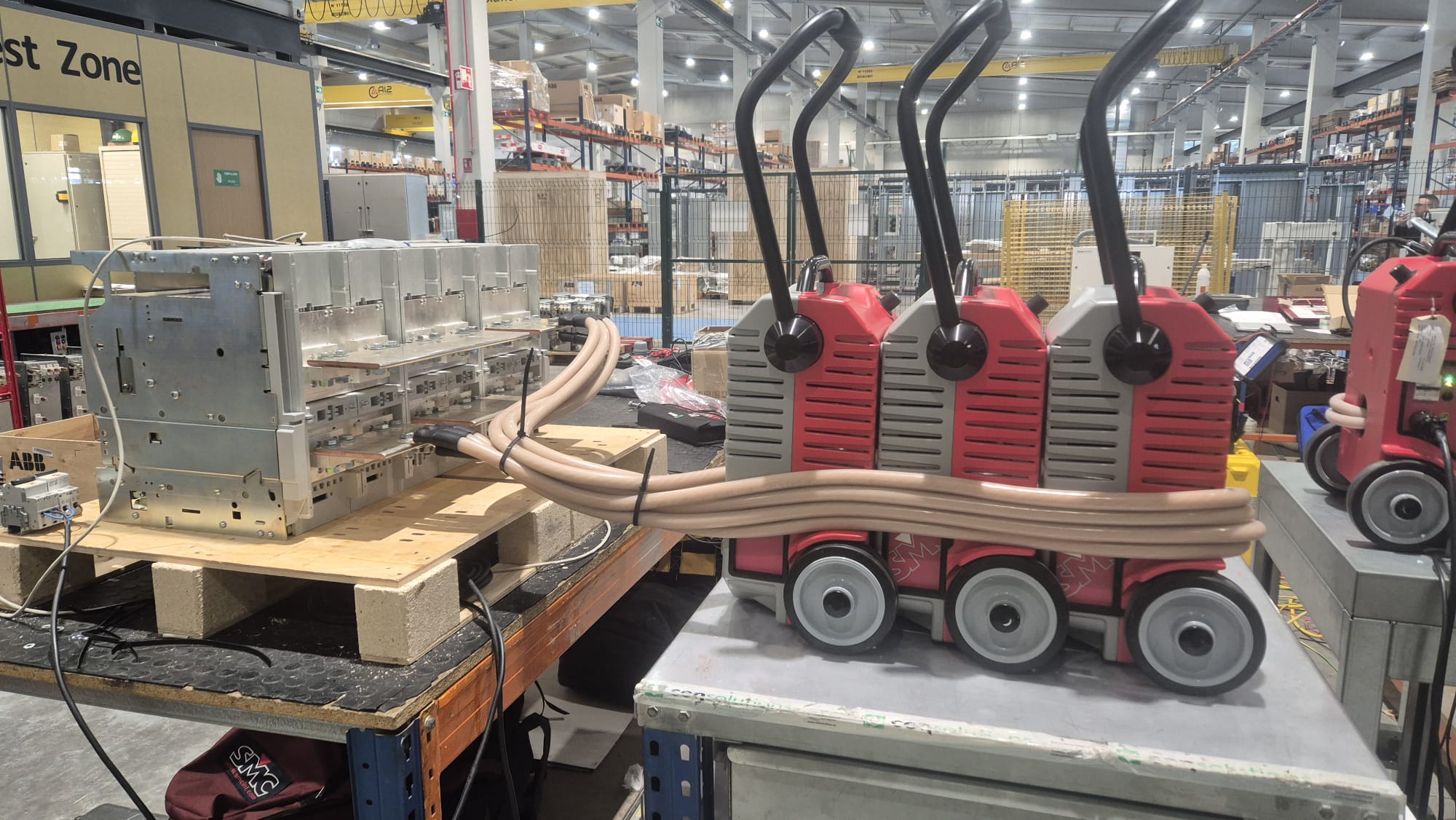
This is where Raptor becomes a natural reference. Raptor is a multifunctional modular primary testing system built for commissioning and routine testing of primary equipment. It has a 35 kg master unit, stabilized output, a pass-through technique that helps increase compliance voltage in the field, and maximum current injection up to 9,500 A in the base system or 15,000 A with slave units. It can also test circuit breaker, recloser, CT and switchgear testing among other applications.
Where secondary injection fits in data center maintenance
Secondary injection remains just as important, but it solves a different problem. A good secondary injection program verifies protection relay settings, logic, pickup values, timers, interlocks and IEC 61850 behavior without forcing thousands of amps through the primary circuit. In live or partially energized data center environments, that usually means faster testing, less disruption and better repeatability for periodic maintenance.
Secondary injection is especially useful after firmware changes, retrofit work, setting revisions or selectivity studies. It is also the practical tool for regular relay validation when the operator wants to confirm the brain of the scheme without opening a wider operational window.
For this stage, Quasar and Mentor 12 fit different levels of complexity. Quasar is an advanced three-phase relay tester for secondary and IEC 61850 protections, with Wi-Fi or Ethernet connectivity and modular expansion options. For broader or more demanding protection-scheme work, Mentor 12 is a PC-independent modular relay tester that can scale up to 12 currents and 6 voltages, which is especially useful in channel-intensive commissioning or advanced protection testing.
A circuit breaker test strategy for critical power
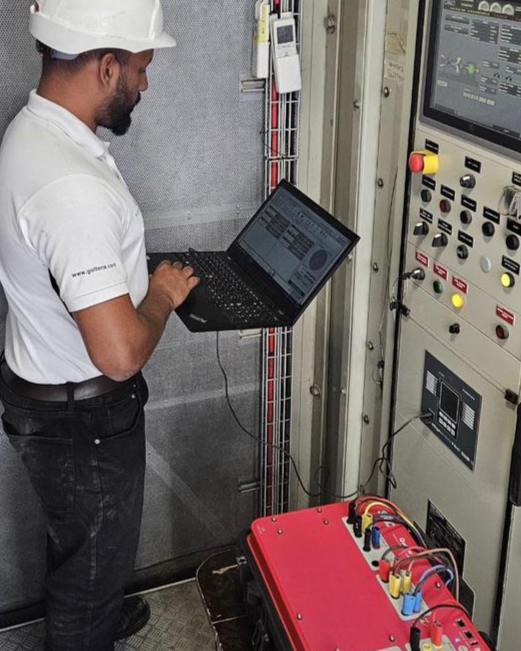
A dependable AI data center also needs more than one type of circuit breaker test. On low-voltage distribution, primary injection is often the best way to prove thermal and magnetic trip performance under realistic conditions. On medium- and high-voltage breakers, timing analysis, contact resistance, coil-current analysis and dynamic resistance data become increasingly valuable.
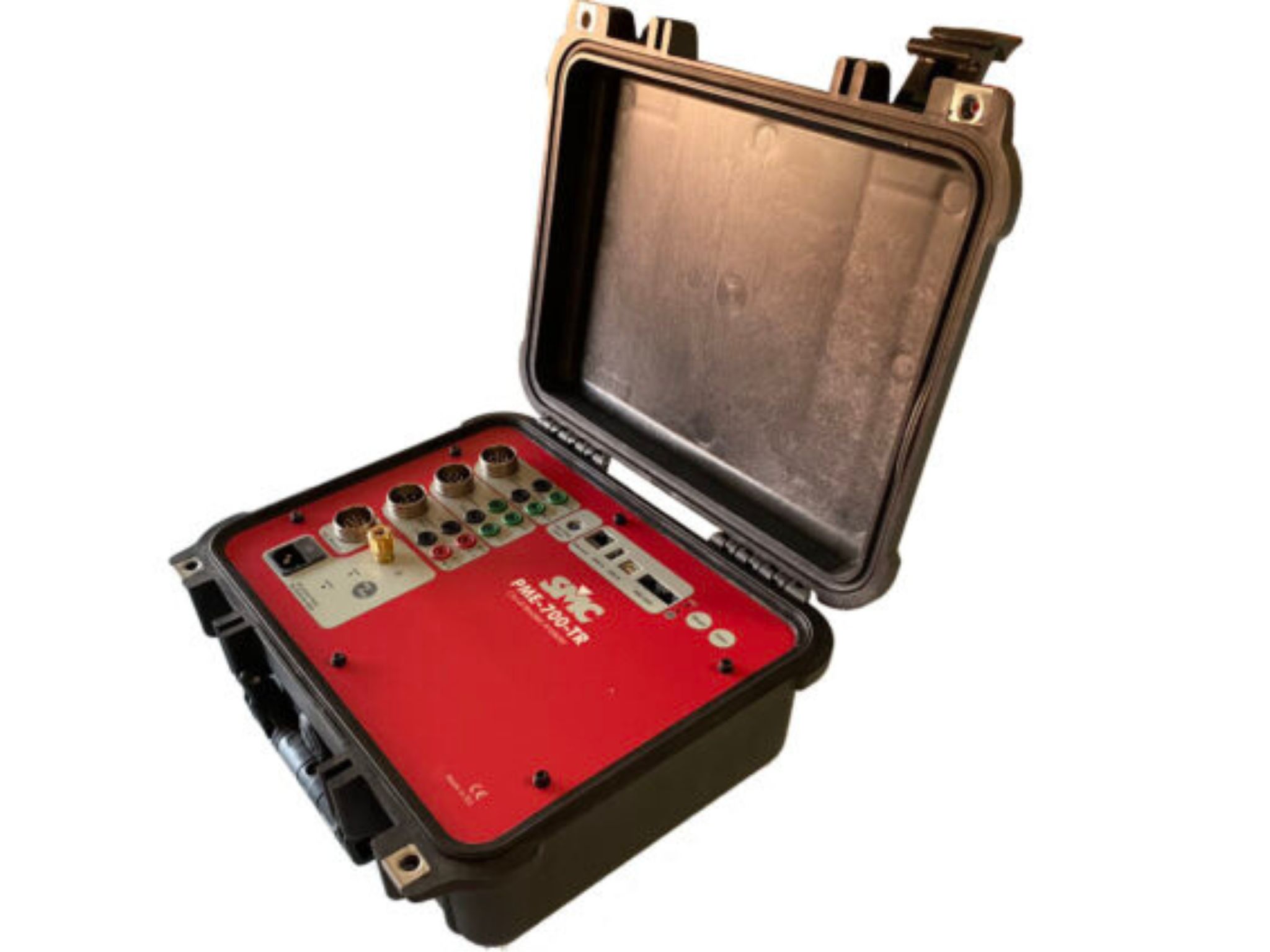
This is where dedicated breaker tools add depth to the maintenance program. SMC’s PME-700-TR is as a power circuit breaker analyzer for medium- and high-voltage three-phase breakers. It records open and close transitions with 0.1 ms resolution, supports graphical and numerical evaluation of coil currents, and also includes three-phase 4-wire contact resistance measurement.
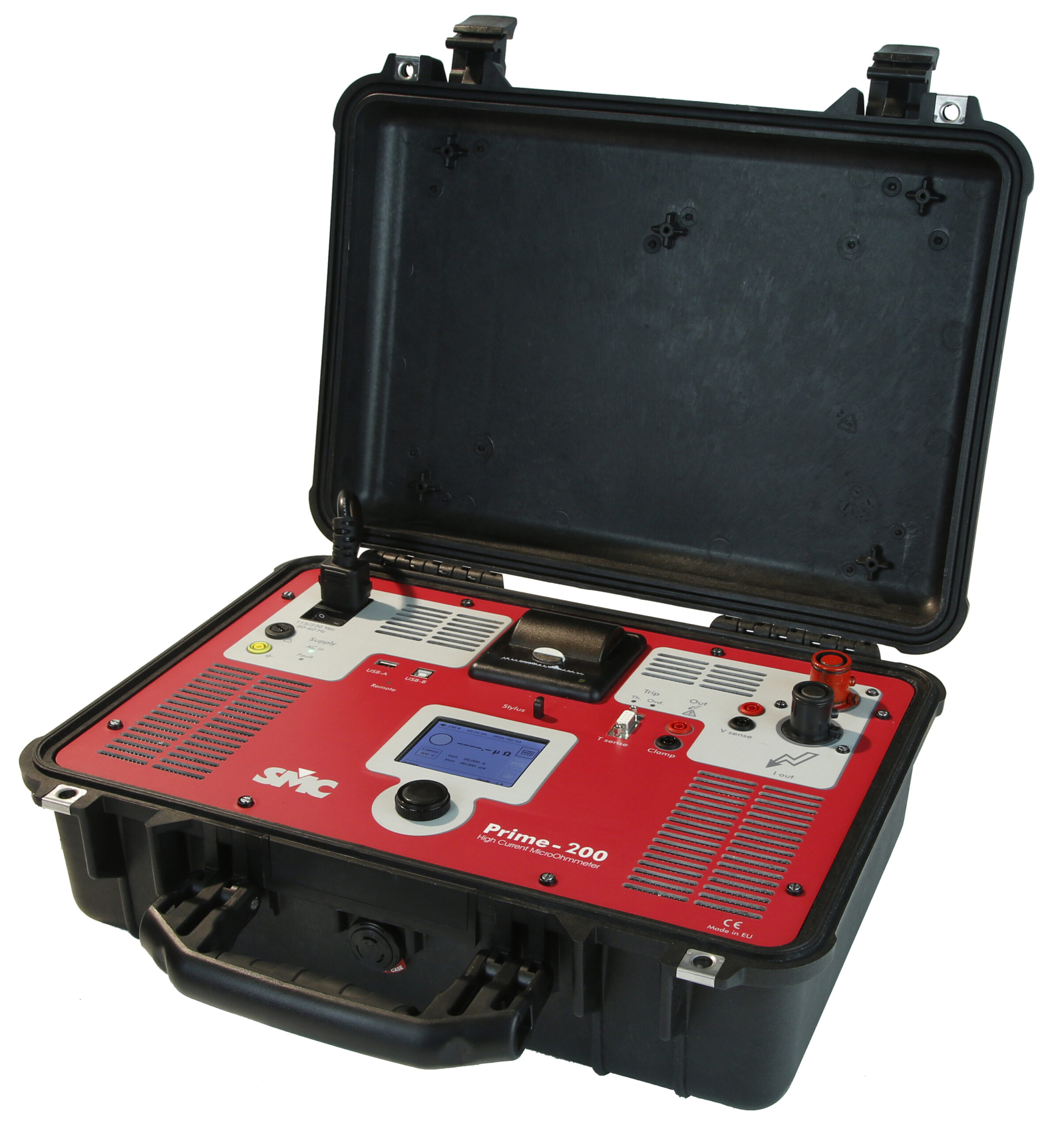
For deeper contact assessment, the PRIME family adds static contact resistance and dynamic resistance measurement (DRM). SMC’s PRIME 200 and PRIME 600 combine contact resistance and DRM in one unit, which is highly relevant for evaluating contact wear in SF6 and vacuum circuit breakers without combining several instruments. In other words, a solid circuit breaker testing strategy in a data center should not stop at trip timing alone.
A practical testing workflow for commissioning and uptime
The most effective approach for an AI data center is not to choose between primary injection and secondary injection. It is to combine them in a sequence that reflects real operational risk.
Start with secondary injection to validate relay logic, settings and communications. Follow with primary injection to verify the complete trip path under real current. Add dedicated circuit breaker testing to confirm opening and closing times, coil behavior and contact condition. Then use maintenance intervals and asset criticality to decide when deeper breaker diagnostics such as contact resistance or DRM should be repeated.
From a product-positioning perspective, the SMC portfolio maps cleanly to that workflow: Raptor for high-current primary injection, Quasar for efficient routine secondary injection, Mentor 12 for more complex or channel-intensive protection schemes, PME-700-TR for breaker timing and operational analysis, and PRIME 200/600 for contact resistance and dynamic resistance diagnostics. That combination supports a broader electrical reliability strategy instead of a single-test approach.
Conclusion
As the data center becomes denser and more power-intensive in the age of artificial intelligence, the cost of incomplete testing rises. Primary injection, secondary injection and circuit breaker testing each address a different layer of electrical risk. When they are used together, the result is better protection coordination, safer energization, fewer hidden defects and more reliable uptime.
For a modern AI data center, the question is no longer whether to test. The real question is whether the testing depth matches the electrical consequences of artificial intelligence workloads.
For more information, please contact us

